

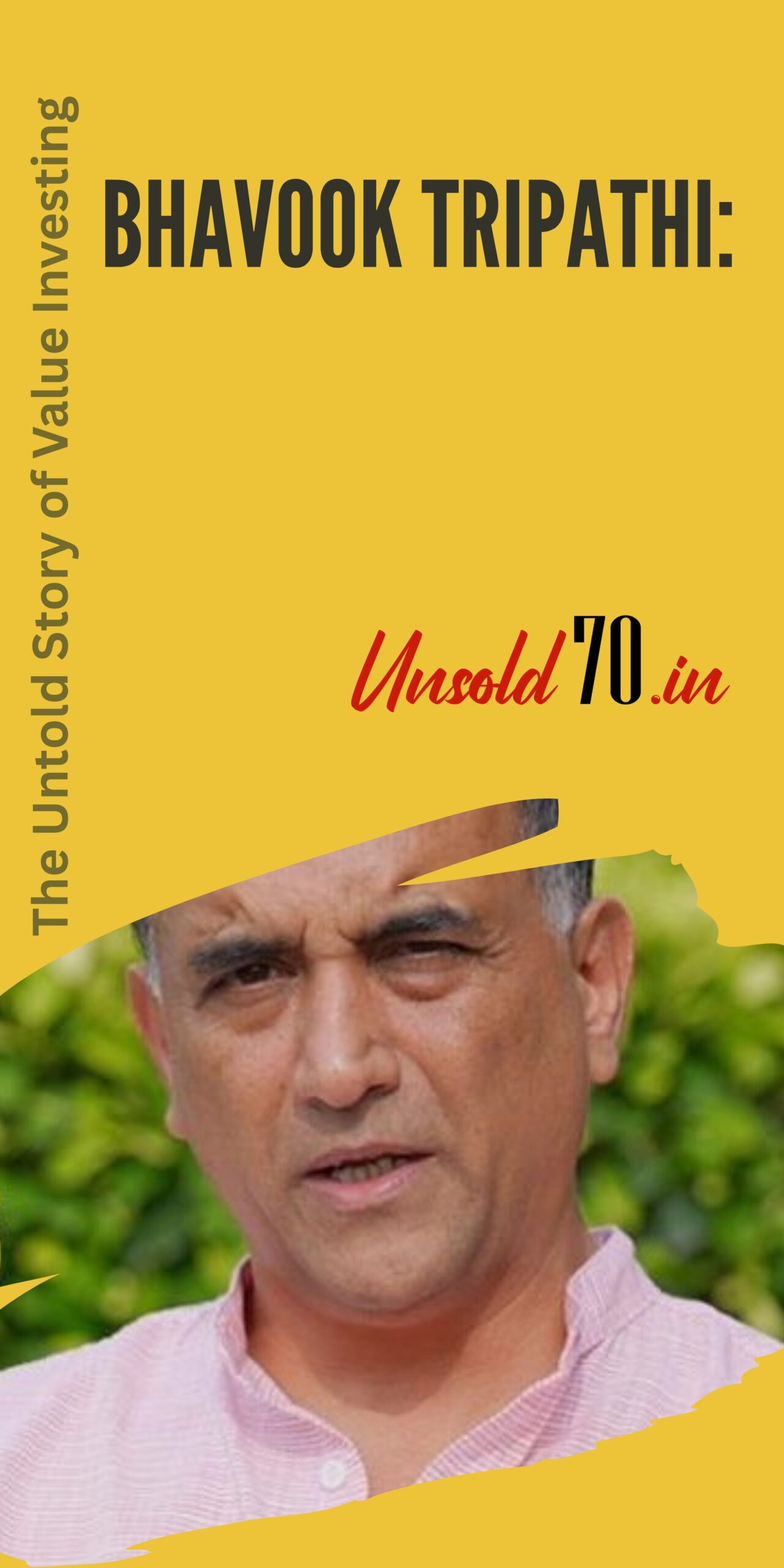
Bhavook Tripathi: The Untold Story of Value Investing
Quick Profile
Full Name:
Bhavook Chandraprakash Tripathi
Quick Identification:
The founder of Brahm Corporation
Profession:
First-generation Entrepreneur and Investor
Investment Portfolio:
Mr. Bhavook has an investment net worth of over Rs 950 Cr. He publicly holds 3 stocks.
Core Philosophy:
Buy when the market is ignoring a stock
Early Life
Bhavook Tripathi biography tells us about his overall investment journey, starting from his education. Bhavook Tripathi completed his early schooling in Bangalore and graduated from IIT BHU Varanasi in Metallurgical Engineering. Carrying a middle-class background, he pursued his higher studies in finance at the University of Wyoming. He got his financial knowledge from his academic curriculum. That’s why his education was a combination of engineering and trade. His early life shaped his curiosity about the markets, systems, and how things work.
Mr. Tripathi was working as an investment banker in the USA. In 1994, he left the USA and laid the foundation of Sanshu Industries in Aurangabad along with his father. This industry was involved in supplying high-precision machined components to domestic car manufacturers.
How Did He Enter the Stock Market?
Many investors were trying to chase information technology and the dot-com boom in the late 1990s. If we study the famous investor biographies, including Bhavook Tripathi biography, we come to know a few other things related to this. However, Mr. Tripathi identified a blue-chip auto-ancillary company with a small market capitalisation of only around ₹35 crore. Yes, he looked in the opposite direction and found FAG Precision Bearings. In this deal, he tried to recognize its hidden potential and futuristic approach. However, Mr. Tripathi held the investment for around seven years and made more than ₹10 crore in profit.
Timeline
1994 — Returns to India
He returned to India after working with a San Francisco-based boutique investment bank. Earlier, he finished his finance studies at the University of Wyoming.
1999 — Sanshu Industries
He founded Sanshu Industries, an auto-ancillary supplier with the support of his father. It helped him gain operational expertise in precision engineering.
1999 — Followed the tech boom
He followed the tech boom and invested in FAG Precision Bearings with a market capitalisation of only around ₹35 crore. He also purchased stocks of Wipro and Infosys.
2001 to 2003 — Buying During Market Weakness
There was a downfall in the market from September 2001 to March 2003. During that period, he tried to find companies with attractive valuations. Hence, he bought stocks of Hindalco, Neyveli Lignite, and Karnataka Bank.
2006 — FAG Bearings Exit
Tripathi held more than six lakh shares of FAG Bearings and started selling those stocks at a good valuation of around ₹500 per share. This deal helped him make more than ₹10 crore from a single stock sale.
2006 — Solvay Pharma
After the exit, he started focusing on Solvay Pharma and bought a substantial portion at around ₹400 to ₹500 per share. Surprisingly, he sold those shares when they reached above ₹3,000.
2007 — R Systems Investment
Within a year, he ended this deal with a whopping ₹10 Crore return. Tripathi then entered R Systems International as one of the most important investments of his career.
2010 — Exit from Solvay Pharma
After a few years, he invested ₹5 Crore in Solvay Pharma and made ₹59 Crore upon its Abbott merger.
2017 — Way to Entrepreneur
He moved his career a step ahead and became an Entrepreneur in 2017. He expressed his intention to build businesses rather than simply owning shares in businesses.
2024 — Virat Industries
Virat Industries disclosed an agreement with Mr. Tripathi for around 1 crore shares at ₹104 per share. So, it was an investment worth approximately ₹100 crore.
Investment Philosophy
Thousands of people are clueless and invest their money here and there, with the expectation of a miracle. But Mr Tripathi believes a different thing. If we conclude the investing philosophy of this entrepreneur, we find the words of Gordon Gekko, “The public’s out there throwing darts at a board, sport. I don’t throw darts at a board – I bet on sure things’’.
As per Bhavook Tripathi biography, he tries to find out companies that have unfavourable macroeconomic conditions, regulatory back push, or any such temporary setbacks. Hence, Bhavook Tripathi invests in a company that has unfair setbacks. His philosophy was to buy when a quality business is overlooked and sell when your valuation target is reached.
- Do deep research and buy what you understand
- Look where others aren’t looking
- Concentrate when conviction is high and prefer to create a good position.
- Don’t blindly follow the crowd
- Pay attention to valuation
- Develop a discipline of exit
Why does Unsold70 prefer to publish Bhavook Tripathi’s biography?
Bhavook Tripathi’s experience set combines engineering, manufacturing, entrepreneurship, and investment. He didn’t come from a business or investment background, but he mastered the art of company selection. Even if he was profiled as a relatively low-profile investor by a top business magazine, his investment strategy perfectly fits into the Unsold70 strategy selection framework.
Tripathi is a research-driven person when it comes to investing. Bhavook Tripathi biography says, he neither depended on market popularity nor believed in 52-week lows. Mr. Tripathi tries to look at a company that had price corrections due to unexpected corporate noise, temporary market panics, or sector-wide sell-offs. He did not simply screen companies based on 52-week high or 52-week low lists. Instead, he always tried to find out the valuation and reasons behind market sentiment.
Famous Quotes
In 2017, while discussing his decision to focus more on building businesses, Mr. Tripathi said, “Today’s valuation is good for selling your business and not buying.”
He focused on contrarian conviction and once said, “I want more and more people to be sceptical about R Systems” while discussing R Systems.
He focused on attractive businesses and focused on buying a stock when the market is ignoring a stock. He said, “I like to time my purchase when a stock is out of favour” while explaining his investment style in FAG Bearings. He also mentioned, “For me it was all about companies that were growing and in an attractive business.”
He was asked to discuss his asset allocation approach. In the reply, he asked another question, “If the market is dynamic, how can one follow a static asset allocation model?”

Rajib Kar
Related Posts
Anil Kumar Goel Biography: Portfolio, Career & Investment Philosophy
Anil Kumar Goel: India's "Sugar Baron" and the Discipline of Deep-Value…
Raamdeo Agrawal: From Rural Roots to India’s Value Investing Icon
Discover the inspiring journey of Raamdeo Agarwal, one of India's most…

Nikhil Kamath Biography: The Journey From Trading to Zerodha
Discover the inspiring journey of Nikhil Kamath, the co-founder of Zerodha,…
Leave a Reply