

Karur Vysya Bank Story: Is It India’s Most Underrated Bank?
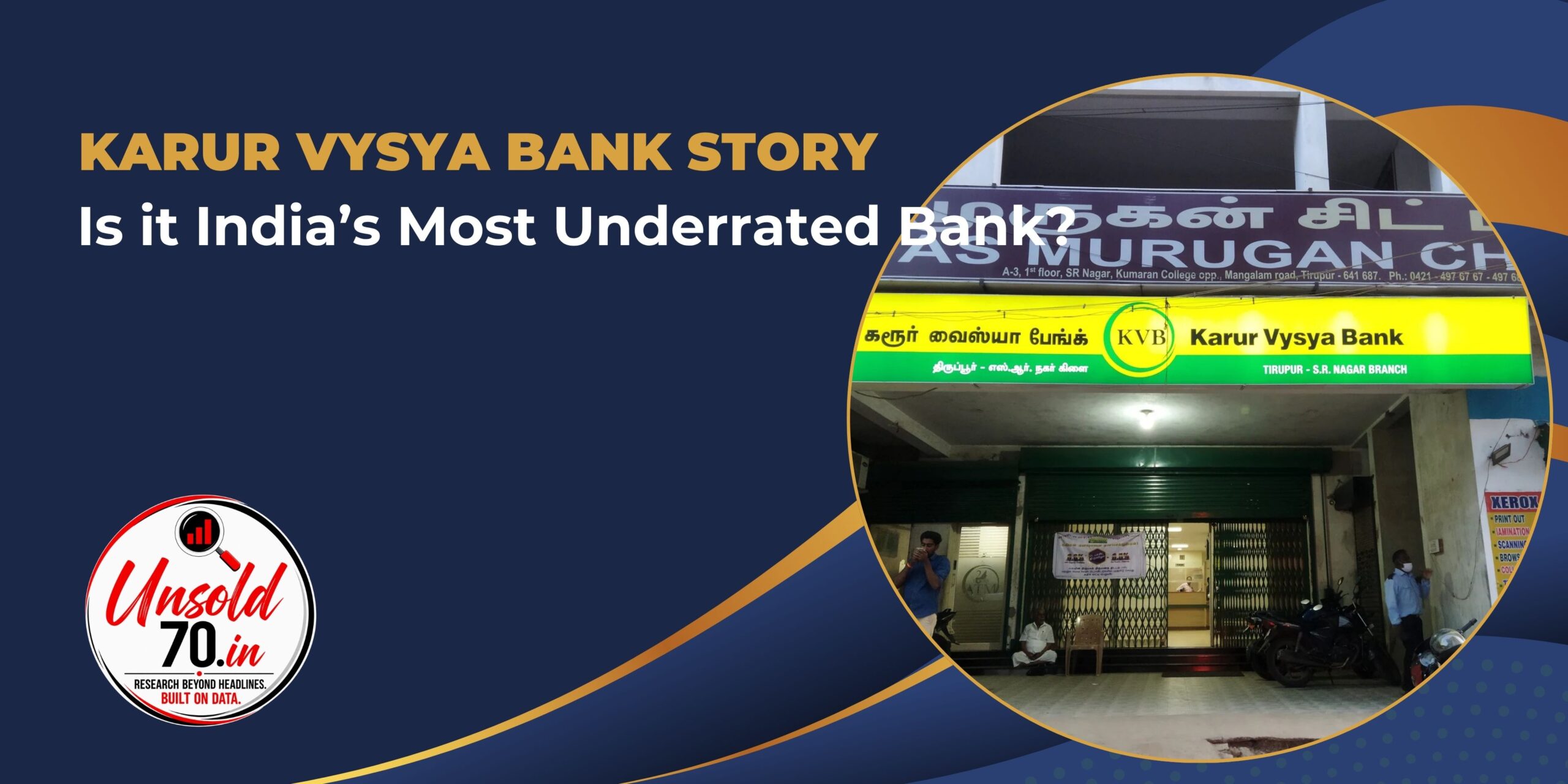
India’s banking industry, which is regulated by the RBI, is comprised of large financial institutions, co-operative institutions, structured commercial banks, and specialized financial bodies. That’s why a bank does not need to be among the biggest for building a compelling business. Karur Vysya Bank, an Indian private sector bank, offers interesting case studies in how a regional banking franchise can improve operating performance and drive growth. Established in 1916, this banking institution is headquartered in Karur, Tamil Nadu. They provide corporate, retail, and treasury banking services across the subcontinent. Now you may ask, is Karur Vysya Bank story genuinely an underappreciated banking business, or does its valuation already reflect its strengths.
Karur Vysya Bank: A Brief History and Business Overview
Continue progress in serving for individuals, businesses, and communities has been the key highlight of Karur Vysya Bank’s growth journey. This banking firm is supporting local enterprises in getting financial assistance with the aim to create lasting impact. It became a scheduled bank after 36 years of establishment and started expanding their services as a national bank. They are engaged in operating Treasury Operations, MSME, Agricultural Banking, Retail Banking, and Corporate Banking.
What Makes Karur Vysya Bank Story Different?
KVB, which started its operations with just ₹1 lakh, is growing by more than 12% as its portfolio reached ₹34,279 crore in FY 2025–26. It keeps its focus in maintaining relationships with small and medium-sized businesses across the country. They use technology-enabled transaction banking and credit assessment in order to support small and medium-sized businesses. They are now present in multiple states and Union Territories with multiple branches. These branches have specialized Business Banking Units, ATMs, and Corporate Banking Units.
Does It Have Sustainable Growth?
If we go inside the Karur Vysya Bank story, we come to know about its consistent business growth that is supported by its asset quality and profit making ability. They are maintaining a year-on-year growth of approximately 15%, which is not bad for sure. This banking institution has done a business of ₹2,14,420 crore and deposits reached ₹1,15,666 crore in FY 2025–26. These figures are indicating that they are intensifying their lending operations while continuing to attract customer deposits. Even though the business expansion of KVB bank is encouraging, its long-term growth depends on stable profitability, disciplined lending, efficient operations, deposit growth and maintaining strong asset quality.
Is Karur Vysya Bank Undervalued?
Its current stock price is Rs 345.65 which is slightly lower than its 52 week high. However, its 52 week low was Rs 221.18. Now the question is, whether this banking institution is overvalued or undervalued? The ROE of Karur Vysya Bank is 16.45%, as it uses its shareholder capital for generating profits. However, its ROA of this bank is 1.62%. These elements indicate good profitability and effective asset management.
Karur Vysya Bank story looks moderately valued with its current P/E ratio of 11.4 to 11.97. Interestingly, this P/E ratio sits closely with its industry average P/E ratio of 13.39. On the other side, the P/B ratio of this bank is 1.87 which is also moderately valued. It means the stock price is less than twice its book value.
Image Credit: Canva
Disclaimer:
Unsold 70 publishes research-based articles to help readers understand businesses and the stock market. These are not investment recommendations, as past performance does not guarantee future results. You should perform your own research and seek advice from a SEBI-registered financial advisor before making investment decisions. Our weekly research page will give you a highlight of our weekly research.

Related Posts

India’s Metro Expansion: The Opportunity for Titagarh Rail Systems
India is undergoing unprecedented urbanization. Rapid modernization and expansion of the…

TCS Success Story: How It Became India’s Largest IT Company
Discover the TCS success story, from its beginnings in 1968 to…

10 Characteristics of A Good Management Team
What makes a management team effective? Explore 10 essential characteristics of…
Leave a Reply