



Anil Kumar Goel Biography: Portfolio, Career & Investment Philosophy
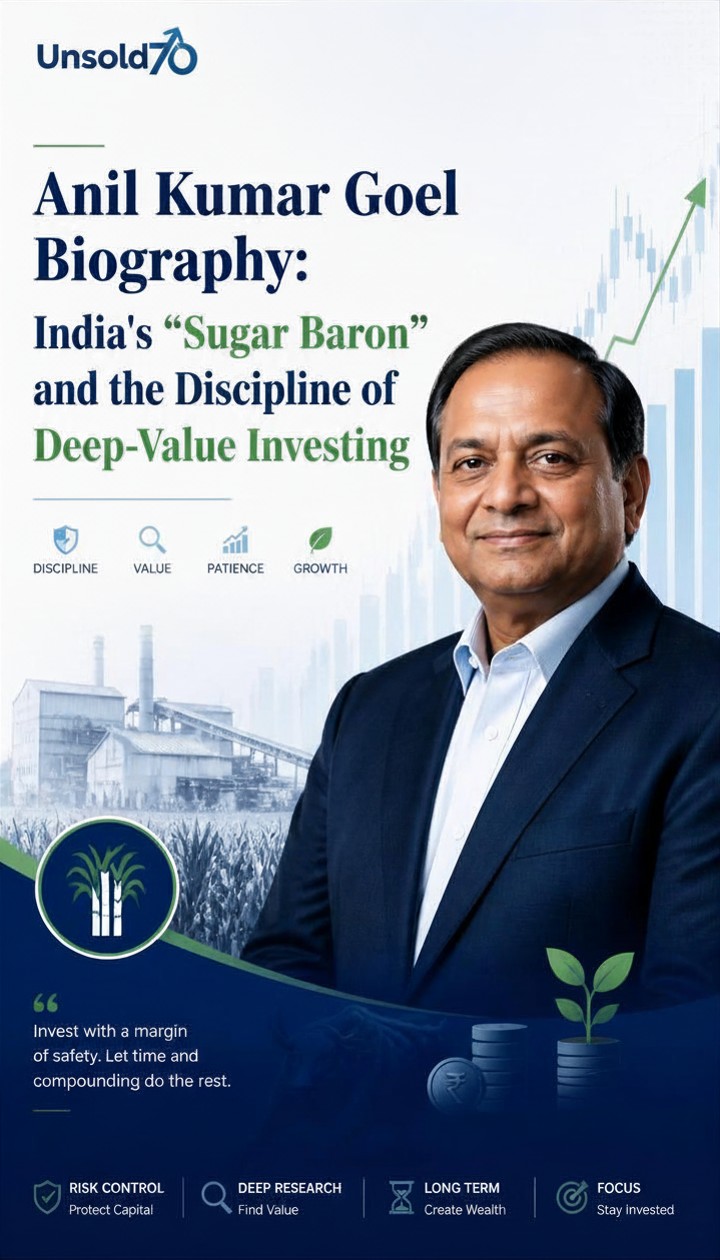
Anil Kumar Goel: India’s “Sugar Baron” and the Discipline of Deep-Value Investing
The career of Anil Kumar Goel did not start in a typical place for an investment banker. It began in a small family-owned business where he learned the value of trade, working capital, inventory, and demand and supply. He had seen how the fluctuations in business could influence the stock market, and he always saw numbers in terms of business realities and managerial intentions rather than mere digits. In addition, running a trading company made him understand how business cycles could dictate the performance of any organization. For instance, he saw how commodities influenced the trading business, how people could take advantage of demand-supply gaps, and how credit management could be beneficial or otherwise. This wealth of experience in the business informed his investment decisions as an investment banker and businessman.
- Learned business economics before stock market theory
- Patience cultivated through day-to-day business cycles, not getting sucked into “short-term price swings”
- Realized that cash flow and efficiencies are more important than whatever ephemeral “story” is driving the market at any given time
How He Entered the Stock Market
Goel entered the stock market at a time when it was full of speculation. Investors who engaged in the market would rely only on rumors and hot tips. Action in the market was ruled by guesswork. The market value of any particular stock had little or nothing to do with reality. But rather than speculate with other traders, Goel saw himself as an entrepreneur who was simply looking to invest in businesses.
Goel turned trading steel into a game of discovery. He looked for diamonds in the rough. He read about companies, their promoters, debts, and profits. He studied things so that he could separate speculation from reality. It gave him intellectual relief, a way to think about building wealth rather than chasing it.
- Treated stocks as ownership in businesses rather than trading instruments.
- Focused on industries where market pessimism created attractive valuations.
- Built conviction through research instead of following popular sentiment.
Biggest Investments
Anil Kumar Goel became a celebrity in India due to his significant investments in the sugar industry. He is also referred to as the “Sugar Baron” because of his successful ventures in this field. The sugar baron’s interest in the industry was related to the idea that downturns and cyclicality were frequently mistaken for decline by the market.
While others were investing in politically connected and highly leveraged sugar mills, Goel was purchasing those that were considered “value traps.” The Sugar Baron built an impressive portfolio of engineering, manufacturing, chemical, infrastructure, and industrial companies, all of which were grounded in realism. Goel’s rationale was based on a belief that the likelihood of success for his investments would outweigh the risks.
- Built a reputation through deep-value opportunities in sugar companies.
- Favored cyclical businesses trading below intrinsic value.
- Demonstrated conviction by remaining invested through uncomfortable market corrections.
Failures and Lessons
Like any other successful value investor, Goel has also experienced instances where the market failed to recognize the value in a stock for an extended period of time. Investing in an undervalued stock can be disheartening for many investors due to the prolonged period of depression that such stocks undergo. Thus, Goel faced multiple instances where his intellect had to override his emotion in order to continue holding on to a stock that had lost value due to various market forces.
The market corrections also taught him another valuable lesson, which was the need for buying stocks with a sufficient margin of safety. Despite a company having fundamental value, there are several other factors that can affect the price of a stock. Factors such as legal issues, operational losses, and external economic causes, among others, can contribute to a stock’s price falling below its intrinsic value. Consequently, Goel learned the importance of adopting a cautious approach when buying stocks as a measure of minimizing risks.
- Patience frequently matters more than prediction.
- Cheap businesses are not always valuable businesses without improving fundamentals.
- Risk is reduced through valuation discipline rather than excessive diversification.
Investment Philosophy
At the heart of Mr Goel’s investment philosophy is the simple but subtle idea that he only buys businesses, not marketplaces. That is, Goel focuses his attention on an asset’s value, financial strength, management, and competitive position in the market. It is a different approach to investing that does not get tempted by market wobbles and concentrates on a business’s long-term value.
- Prioritize fundamentals over forecasts.
- Allow time—not frequent trading—to unlock value.
- View volatility as a pricing mechanism rather than a measure of business quality.
His approach is almost like an economist’s view of investing as opposed to a speculator’s. The tendency of the markets to fluctuate in volatilities has no bearing on Goel’s philosophy of investing. On the contrary, falling prices are an opportunity for investment since the value of the underlying business will always rebound to reflect its true value. In short, Goel takes advantage of market fluctuations to buy quality businesses at a discount.
Net Worth Growth Journey
Goel’s wealth accumulation illustrates the mathematics of disciplined capital compounding rather than rapid speculation. His portfolio grew through years of seeking out and finding value in underestimated companies, riding out market slumps, and making profits by letting a company’s own efforts generate dividends and share offerings. He has made money by doing not any of these things at particularly spectacular times, but rather by consistently doing them over and over again. His public holdings in various Indian listed firms, disclosed in filings over numerous years, suggest a similar pattern of investment. His positions in these firms have varied as the market dictated, but they have consistently reflected an ability to recognize underlying value in a business, even when that was out of favour with the market.
- Wealth grew through patience instead of constant portfolio turnover.
- Conviction increased as research deepened.
- Long-term compounding consistently outperformed emotional decision-making.
Key Advice for Beginners
Goel’s investing philosophy offers valuable insight to novices who get lost in the modern deluge of financial information. From both an anecdotal and evidential perspective, his experiences can guide would-be investors through the mire of contradictory news reports, opinions from financial pundits, and the sheer noise of social media. Goel’s parable suggests that patient investing—informed by business economics rather than fickle market fluctuations—produces rewarding results.
Study businesses before studying stock prices.
Ignore market noise and focus on intrinsic value.
Invest with a long-term horizon supported by research and conviction.
His description of his own investing decisions serves to illustrate the virtue of independent thinking and thorough research. To conduct proper due diligence, an investor must be willing to pore over reports, read between the lines of competitors’ statements, and understand the nuances of management before putting money down. By exercising patience and prudence, an investor will find far greater rewards than those who chase after every fluctuation.
Famous Quotes
The market rewards patience far more consistently than excitement.
A falling stock price is not necessarily a falling business.
Real wealth is created by owning fundamentally strong businesses through economic cycles.
Noise disappears when fundamentals become the center of every investment decision.
Although Mr Goel may not be someone who talks a lot about their investing philosophy, their actions certainly speak volumes. Their approach to investing is encapsulated in the principles that guide their investment choices, which in turn contribute to their stature as a respected investor in the field.

Related Posts
Bhavook Tripathi: The Untold Story of Value Investing
Bhavook Tripathi, a value investor known for his long-term investment approach.…
Raamdeo Agarwal: From Rural Roots to India’s Value Investing Icon
Discover the inspiring journey of Raamdeo Agarwal, one of India's most…
Nikhil Kamath: The Contrarian Who Rewired India’s Investment Landscape
Discover the inspiring journey of Nikhil Kamath, the co-founder of Zerodha,…
Leave a Reply